.png)
Grand Prismatic Spring
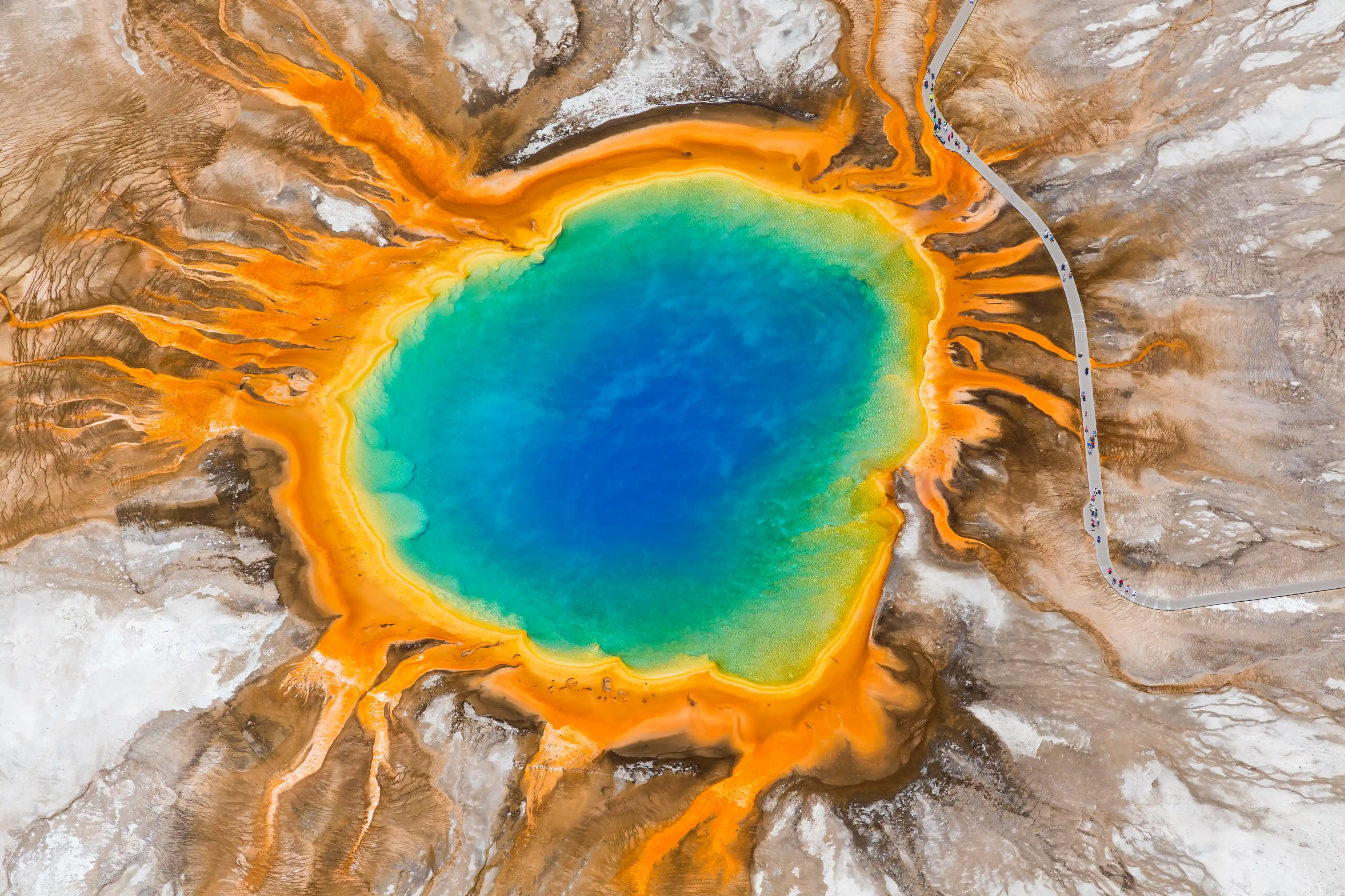
Grand Prismatic Spring, Yellowstone National Park
The largest hot spring in the United States — a rainbow-colored wonder bigger than a football field, about two hours and forty-eight minutes from your door at Xhale.
📍 Midway Geyser Basin, Yellowstone National Park, WY · ~131 miles from Xhale Resort and Spa · ~2 hrs 48 min drive · Open April–October
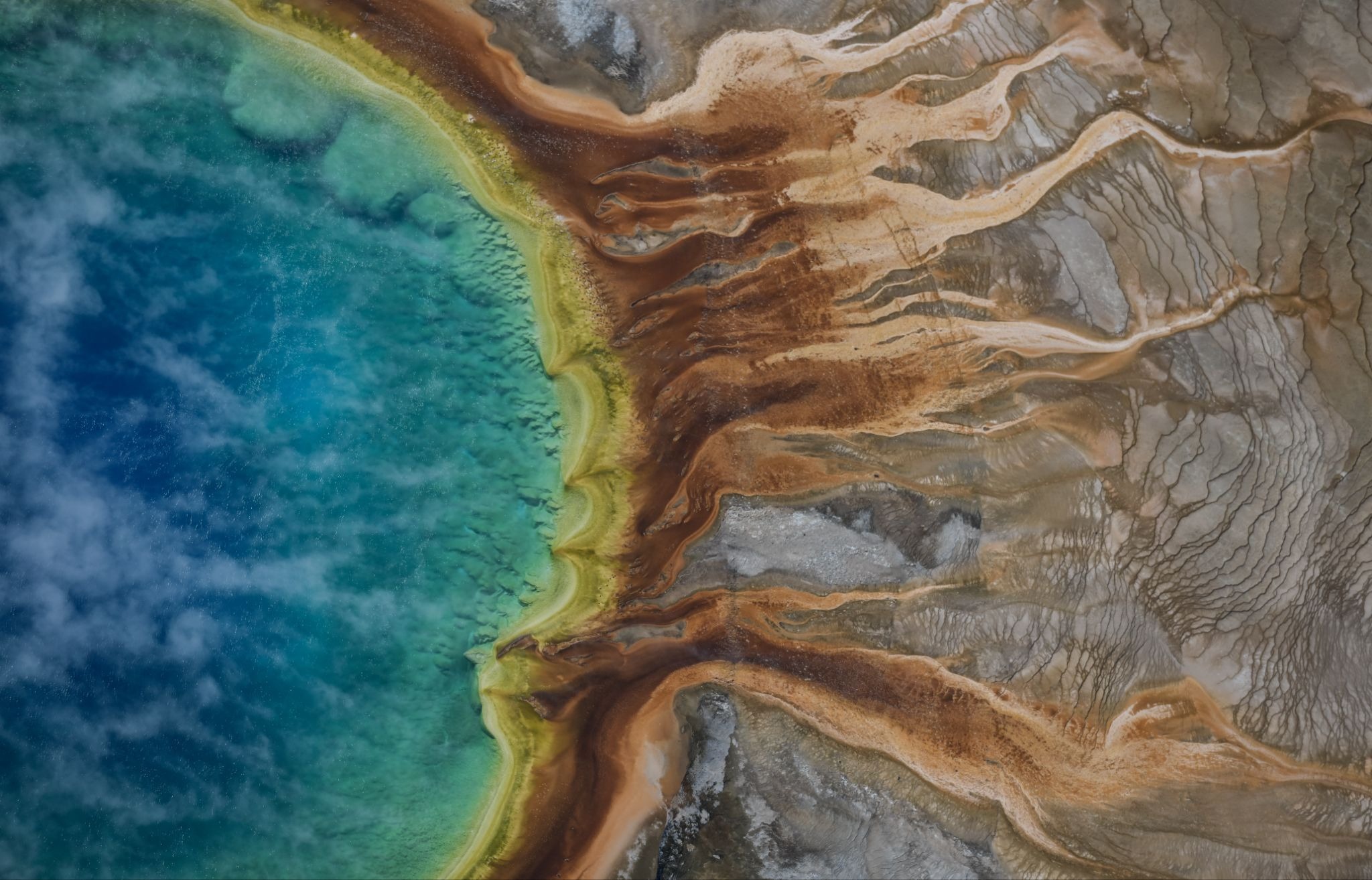
There are natural wonders you read about and then there are ones that stop you completely when you finally see them in person. Grand Prismatic Spring is the second kind. The colors alone are surreal — a deep sapphire blue at the center fading through vivid turquoise, green, yellow, burnt orange, and rust red at the edges — all billowing with steam against the wide Wyoming sky. It's the most photographed geothermal feature in Yellowstone National Park, and once you've seen it from above, it's easy to understand why.
It's also one of the most accessible stops in the park. No serious hiking required. No equipment needed. Just a clear morning, comfortable shoes, and a willingness to be genuinely astonished.
🌿 The night before matters An early departure from Idaho Falls gets you to the park before the crowds. Set yourself up right with a restorative evening at Xhale Resort & Spa — a massage, a hot pool soak, an early night. You'll feel the difference on the drive. Explore treatments at Xhale → xhaledayspa.com
What is Grand Prismatic Spring?
Grand Prismatic Spring in Yellowstone National Park is the largest hot spring in the United States, and the third largest in the world, after Frying Pan Lake in New Zealand and Boiling Lake in Dominica. It is located in the Midway Geyser Basin. Facebook
The actual diameter of Grand Prismatic Spring at its widest point is 370 feet — longer than an American football field. It is more than 121 feet deep, and water surges to the surface continuously from a crack in the earth below, discharging hundreds of gallons per minute into the surrounding basin. Evedo
The spring sits on top of the Yellowstone Caldera — one of the largest active volcanic systems on earth. Beneath the surface, groundwater seeps down through cracks in the rock, gets superheated by the magma below, and rises back up under pressure. The result is a constantly churning, perpetually steaming pool of near-boiling water that has been active for thousands of years.
Why is it so colorful? The science behind the rainbow
This is one of the most common questions visitors ask — and the answer is one of the most fascinating things about the spring.
The colors that make Grand Prismatic famous are a result of extreme organisms living in the hot water. The center of the pool is near boiling temperature and has a brilliant blue color. Away from the center, different thermophilic species thrive at different temperatures, giving the pool the characteristic pigments found not just at Grand Prismatic, but many hot springs in Yellowstone National Park. Evedo
Thermophiles — meaning "heat-loving" organisms — are among the most extreme life forms on earth. They can only survive in conditions that would be lethal to almost every other living thing. As you move from the boiling center outward toward the cooler edges of the spring, different species of these microorganisms take over, each producing their own pigments as a natural sunscreen against ultraviolet light. The result is concentric rings of color — blue, green, yellow, orange, red — that shift with the seasons as water temperatures change at the outer edges.
This isn't just beautiful. It's scientifically significant. Thermophilic bacteria found in Yellowstone's hot springs have contributed directly to modern medical science — including the development of the PCR test, which underlies COVID-19 testing, cancer diagnostics, and genetic testing. The enzyme that made PCR possible was first isolated from a heat-loving bacteria species found in these very pools. Grand Prismatic Spring is not just a spectacle. It's a window into extreme life — and into the kinds of environments where scientists believe life on Earth may have first emerged.
A brief history
In 1839, a group of four trappers from the American Fur Company crossed the Midway Geyser Basin and made note of a "boiling lake," most likely the Grand Prismatic Spring, with a diameter of 300 feet. It was one of the first recorded European encounters with the spring — though Indigenous peoples had known this landscape for thousands of years before any expedition arrived. Facebook
The most detailed early description came from the Hayden expedition of 1871 — the first federally funded exploration of Yellowstone. In his report, geologist Ferdinand Hayden recorded: "This is perhaps the handsomest spring in the whole Park... I have named it Prismatic on account of the brilliant coloring displayed in it." Evedo
That name has stuck for over 150 years — and the spring is every bit as striking today as Hayden described it then.
Getting there from Xhale Resort & Spa
Xhale Resort & Spa is located at 1421 1st St, Idaho Falls, ID. Grand Prismatic Spring is approximately 142 miles away in the Midway Geyser Basin area of Yellowstone — plan on roughly 2 hours and 48 minutes of drive time in normal conditions.
The route takes you north on US-20 through Rexburg and Ashton toward West Yellowstone, then through the West Entrance and east along the park road. Grand Prismatic Spring is located about 7.5 miles north of Old Faithful in the Midway Geyser Basin. Both stops make excellent same-day companions — see the planning tip below.
Important parking note: There are two separate parking areas for Grand Prismatic Spring, and which one you use depends on what you want to do. The Midway Geyser Basin parking lot (for the boardwalk) is small and fills fast — often by 9 a.m. in peak season. The Fairy Falls parking lot (for the Overlook Trail) is larger but also fills quickly. Plan to arrive before 9 a.m. or be prepared to park along the road and walk in.
Two ways to see it — and why you should do both
Most visitors don't realize there are two completely different ways to experience Grand Prismatic Spring, each offering something the other cannot. If you have the time, doing both is strongly recommended.
Option 1: The Midway Geyser Basin Boardwalk (up close)
The boardwalk at Midway Geyser Basin is 0.8 miles round trip, flat, paved, and wheelchair accessible. It takes you right to the edge of the spring — close enough to feel the warmth of the steam on your face and smell the faint sulfur in the air. From the boardwalk, you'll see the vivid colors at the water's edge, the intricate microbial mats in the shallows, and the scale of the spring as it stretches away from you in every direction. You won't be able to see the full rainbow pattern from here — the spring is simply too large to take in from ground level — but the sensory experience is unlike anything you can get from a distance.
Along the same boardwalk you'll also pass the Excelsior Geyser Crater, Opal Pool, and Turquoise Pool — all striking in their own right. The boardwalk is one-directional, so follow the signs and take your time.
Option 2: The Grand Prismatic Spring Overlook Trail (from above)
This trail gradually climbs 105 feet over 0.6 miles from the Fairy Falls Trailhead to a view looking down on Grand Prismatic Spring and the Midway Geyser Basin. The total hike is 1.2 miles round trip — easy for most visitors, with a moderately steep final push to the viewing platform. The platform opened officially in 2017, before which people were scrambling off-trail to get this view. National Park Posters
From the overlook, the full rainbow pattern of the spring opens up below you in a way that simply doesn't exist at ground level. This is the iconic photograph — the one you've seen on magazine covers and travel sites — and seeing it in person with your own eyes, steam rising over the color rings in every direction, is a genuinely jaw-dropping moment.
The best approach: Do the overlook first. Park at the Fairy Falls lot, hike to the viewing platform, take it all in from above, then drive to the Midway Geyser Basin lot for the boardwalk experience at eye level. You'll have the full picture — literally.
Timing tip: Avoid visiting first thing in the morning if photography or a clear view matters to you. The spring is typically shrouded in dense steam in the early hours, which can obscure the colors completely. Mid-morning to early afternoon on a sunny day offers the best visibility. Arrive at the overlook around 10–11 a.m. for ideal conditions.
Combine it with Old Faithful on the same day
Grand Prismatic Spring and Old Faithful are just 7.5 miles apart along the same park road — making them natural same-day companions from Idaho Falls. A good plan from Xhale:
Depart Idaho Falls by 6 a.m. Arrive at the Fairy Falls parking lot by 8:30–9 a.m. and hike to the overlook before the crowds peak. Then drive to the Midway Geyser Basin boardwalk for a close-up look. After that, continue south to Old Faithful — check the eruption prediction at the visitor center, walk the Upper Geyser Basin boardwalk, and head back to Idaho Falls in the late afternoon. Both stops together make for one of the most complete single-day Yellowstone experiences you can have from a base in eastern Idaho.
✨ Everything you've been carrying deserves to be set down A full day in Yellowstone — the driving, the walking, the sensory overload of one of the most geologically extraordinary places on earth — takes something out of you. The best way to end it is back at Xhale Resort & Spa. Let us restore what the day spent. Book a treatment → xhaledayspa.com
Good to know before you go
Season: The Midway Geyser Basin area is generally accessible from late April through early November, weather permitting. Peak season is June through August — arrive early or expect significant crowds and limited parking.
Entrance fees: Yellowstone requires a park entrance pass. A 7-day vehicle pass is $35, with annual pass options available. Vehicle reservations are not required.
Accessibility: The Midway Geyser Basin boardwalk is fully flat and wheelchair accessible. The Overlook Trail is not suitable for wheelchairs or strollers due to the steep final section and unpaved trail surface.
What to wear: Sun protection is essential — there is very little shade at the boardwalk and the overlook. Bring a hat, sunscreen, and layers for the drive. Sturdy walking shoes or trail runners are recommended for the overlook — flip flops are not a good idea on the uphill section.
Safety: Stay on designated boardwalks and trails at all times. Hydrothermal water at Grand Prismatic Spring is near boiling and can cause severe burns in seconds. The ground surrounding the spring is also fragile and thermally unstable. Do not step off the boardwalk for any reason.
Wildlife: Bison are regularly spotted grazing near Midway Geyser Basin. Give them a wide berth and never approach. Bears are also active in the area — carry bear spray on the overlook trail and know how to use it.
Food: There are no dining options at the Midway Geyser Basin. Pack food and plenty of water for the day. Old Faithful, about 7.5 miles south, has multiple dining options including the Old Faithful Inn Dining Room and the Geyser Grill.
Frequently asked questions
Is the boardwalk or the overlook a better experience? They're different, not interchangeable. The boardwalk puts you in the experience — you feel the heat, smell the sulfur, and see the vivid edge colors up close, but you can't see the full rainbow pattern. The overlook gives you the full picture — the iconic top-down view — but from a distance. Both together take less than 3 hours and give you a complete understanding of the spring. If you truly can only do one, the overlook is the more visually striking of the two.
What is the best time of day to visit for clear views? Mid-morning to early afternoon on a sunny day. Morning steam often obscures the colors from both the boardwalk and the overlook until it begins to burn off, typically around 10–11 a.m. Overcast days reduce the vibrancy of the colors significantly. A sunny, late-morning arrival gives you the best chance of seeing the full rainbow in all its intensity.
Does the color of the spring change throughout the year? Yes — and this is one of the more fascinating things about it. The outer rings shift from orange and red in summer to brown in winter as the cooler seasonal temperatures change which thermophilic organisms can survive at the edges. Summer visits typically show the most vivid and varied color range.
Can I do Grand Prismatic Spring as a day trip from Idaho Falls? Absolutely. The drive is about 2 hours and 48 minutes each way. Leave Xhale by 6 a.m., arrive before 9 a.m., complete both the overlook hike and the boardwalk walk, add Old Faithful if time allows, and be back in Idaho Falls by early evening. It is a full day but very manageable and worth every mile.
Is the overlook hike suitable for kids and older visitors? The first 0.6 miles of the Overlook Trail are flat and easy — suitable for most people. The final section to the viewing platform is steeper with some uneven footing and is not ideal for very young children, older visitors with limited mobility, or anyone in sandals. Most adults in reasonable shape will have no trouble. The boardwalk is flat and easy for all ages.
Helpful resources
- Grand Prismatic Spring — National Park Service: nps.gov/places/000/grand-prismatic-spring.htm
- Grand Prismatic Overlook Trail — NPS: nps.gov/thingstodo/yell-trail-grand-prismatic-overlook.htm
- Yellowstone Park Roads & Season Dates: nps.gov/yell/planyourvisit/parkroads.htm
- Xhale Resort & Spa: xhaledayspa.com