.png)
Oxbow Bend
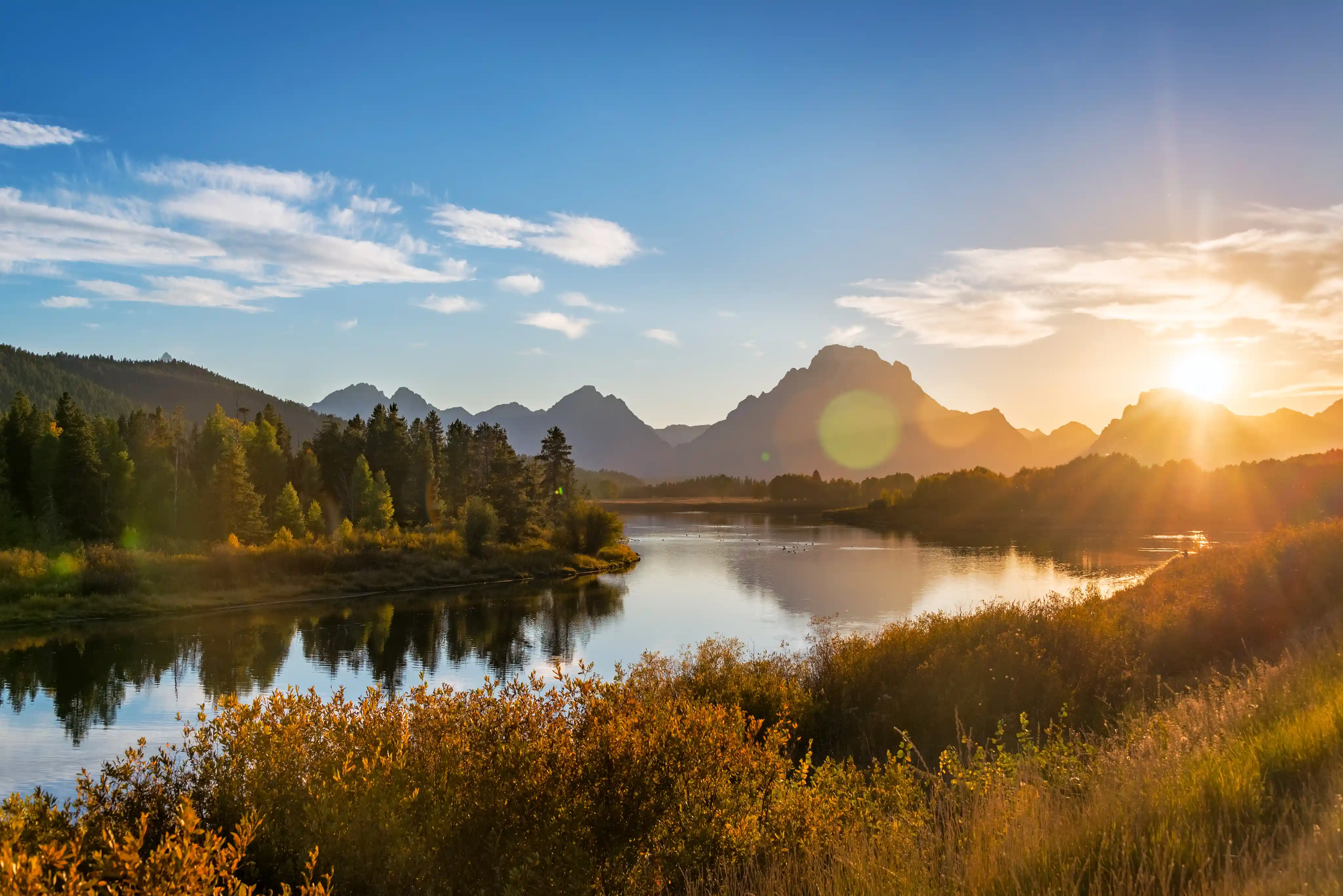
Oxbow Bend, Grand Teton National Park
The most photographed view in Grand Teton National Park — Mount Moran reflected perfectly in a wide, still bend of the Snake River, about two and three quarter hours from Xhale.
📍 Grand Teton National Park, Wyoming · ~130 miles from Xhale Resort & Spa · ~2 hrs 45 min drive · Open year-round, best May–October
There are four spots in Grand Teton National Park that photographers and park insiders call the Famous Four — the views that have appeared on more magazine covers, postcards, and living room walls than any others in the park. Oxbow Bend is one of them. And many who know all four would argue it is the single most iconic of the group.
The view is straightforward and staggering at once. A wide, slow bend in the Snake River curves toward you. Across the water, rising cleanly from the valley floor without foothills or warning, is Mount Moran — a massive, flat-topped peak at 12,605 feet with a glacier still sitting on its upper face. On a calm morning, the entire mountain reflects in the still water below it, doubling the grandeur and creating one of the most perfectly composed natural landscapes in the American West.
And here is the best part for anyone making a day trip from Xhale: you don't have to hike a single mile to see it. You pull into a small parking lot, walk thirty steps to the riverbank, and there it is.
🌿 The view is free. The morning is yours. Xhale makes both better. A sunrise at Oxbow Bend means leaving Xhale Resort & Spa by 5:30 a.m. at the latest. Wind down the night before with a restorative treatment or a quiet soak in the hot pool — the kind of rest that makes a 5 a.m. alarm feel worthwhile instead of cruel. Explore Xhale treatments → xhaledayspa.com
What is an oxbow — and why does this one look the way it does?
The name describes the geography. An oxbow forms when a river meanders in a sweeping curve and then, over time, the main channel cuts off and redirects — leaving the outer curve as a slow, still backwater. Geologically speaking, an oxbow forms when a meander channel is cut off from the main stream forming a pond. AllTrips
The section is named for the crescent-shaped bend in the Snake River waters which looks like an ox's U-shaped collar. The main channel of the river now flows south of the bend, leaving the slow-moving backwaters of the Snake River here. U.S. News & World Report
That slow-moving water is everything. Still water reflects. Moving water breaks up the image. The backwater at Oxbow Bend, protected from the main current and sheltered by willows and aspens along the bank, creates exactly the mirror-calm surface needed to reflect Mount Moran in the kind of clarity that looks almost too perfect to be real. It is real — and it happens here, at this specific bend, because of the river's own history.
The result is without a doubt the most photographed place in the entire park. The image of the Snake River with Mount Moran's reflection is iconic and is probably the most recognized image of Grand Teton National Park throughout the world. 10Adventures
Who is Mount Moran — and what makes it different from Grand Teton?
Most visitors arriving from the south spend their time looking at the Grand Teton — the highest peak in the range at 13,775 feet, sharp and pointed and unmistakable. But as you drive north through the park, another peak begins to dominate the skyline. At Oxbow Bend, that peak is Mount Moran.
Mount Moran stands at 12,605 feet and is distinct from its neighbors in several ways. Its summit is broad and flat rather than pointed. It sits slightly set back from the main wall of the range, giving it a commanding presence over the northern end of the park. And crucially, it carries the Skillet Glacier on its upper face — one of a small number of remaining glaciers in the Teton Range, visible as a pale stripe running down the peak's east face.
From Oxbow Bend, you see Mount Moran straight on, framed by the wide arc of the river and the aspen and willow groves along the bank. In fall, those aspens turn gold and orange — and the combination of colored foliage, still water, and the mountain above creates one of the most spectacular seasonal displays in any national park in the country.
Getting there from Xhale Resort & Spa
Xhale Resort & Spa is located at 1421 1st St, Idaho Falls, ID. Oxbow Bend is approximately 130 miles away — plan on around 2 hours and 45 minutes of drive time in normal conditions.
The route from Xhale takes you southeast on US-26 through Swan Valley and along the Snake River canyon into Jackson, Wyoming. From Jackson, drive north on US-191/89/26 through the park. Pass through Moose Junction and continue north. After passing through Moran Junction and the park entrance on US-26/287, continue approximately 3 miles west and the Oxbow Bend turnout will appear on your left side of the road.
Landmark directions: From Moran Junction, head west on the highway for 3.1 miles — the Oxbow Bend sign will be on your left. From Jackson Lake Junction heading east, it is about 1 mile and Oxbow Bend will be on your right. The view is directly roadside. You cannot miss it.
Route note: Oxbow Bend is in the northern section of Grand Teton — about 33 miles north of Jackson, Wyoming. This makes it slightly further than southern park stops like Schwabacher Landing, but the drive through the park itself is part of the experience.
What to do at Oxbow Bend
Unlike most iconic views in national parks, Oxbow Bend requires almost no effort to reach. It is one of the most accessible viewpoints of any kind in the entire national park system.
The main view — no hiking required Pull into a small turnout off US Highway 89/191, step out of your car, and there's the view. While you can snap some photos and be on your way in a few minutes, visitors report bringing chairs and enjoying a leisurely picnic lunch here. By spending more time here, you increase your chances of seeing wildlife like great blue herons, bears, moose, and otters. Wilderness Walks
The riverbank itself is accessible with a short flat walk from the parking lot — no trail required. Most visitors find a spot along the water's edge and simply stay. The light shifts constantly. Animals move in and out of the willows. The reflection comes and goes with the wind. Spending an hour here almost always feels shorter than it was.
Walk the riverbank A short informal path runs along the water in both directions from the main viewpoint. Walking north along the bank changes your angle on Mount Moran and often puts you closer to the wildlife habitat — the willows and cattails that line the backwater are prime moose territory, especially in the early morning. No formal trail, no distance markers. Just walk until you find your spot.
Wildlife watching This is a prime spot for viewing wildlife in Grand Teton. The area attracts moose, elk, waterfowl, wading birds, bald eagles, and osprey, among other creatures. The best time to see a moose in the area is dawn or dusk. Trumpeter swans — massive white birds with wingspans over seven feet — are regularly spotted on the water here. River otters, beavers, great blue herons, white pelicans, sandhill cranes, and both grizzly and black bears have all been documented at Oxbow Bend. Bring binoculars. This is as rich a wildlife habitat as you'll find at any roadside stop in the park. U.S. News & World Report
Fall color — a reason to plan around The autumn colors in Grand Teton National Park are world-famous, and especially at Oxbow Bend. Thousands of photographers congregate here during the last week of September to catch the incredible golds, yellows, and reds as the aspens turn. If you hit it just right, and if the conditions are good, these colors are unbelievable — and with the legendary backdrop of the Teton Range, it just doesn't get better than this. If your visit falls in late September or early October, prioritize Oxbow Bend above almost anything else in the park. 10Adventures
✨ You made it. Now let us restore you. The drive from Xhale to Oxbow Bend and back is a full day well spent. Your reward waiting in Idaho Falls is a massage table, warm water, and someone else taking care of everything for the next hour. Book a treatment at Xhale → xhaledayspa.com
When to visit — timing the light and the crowds
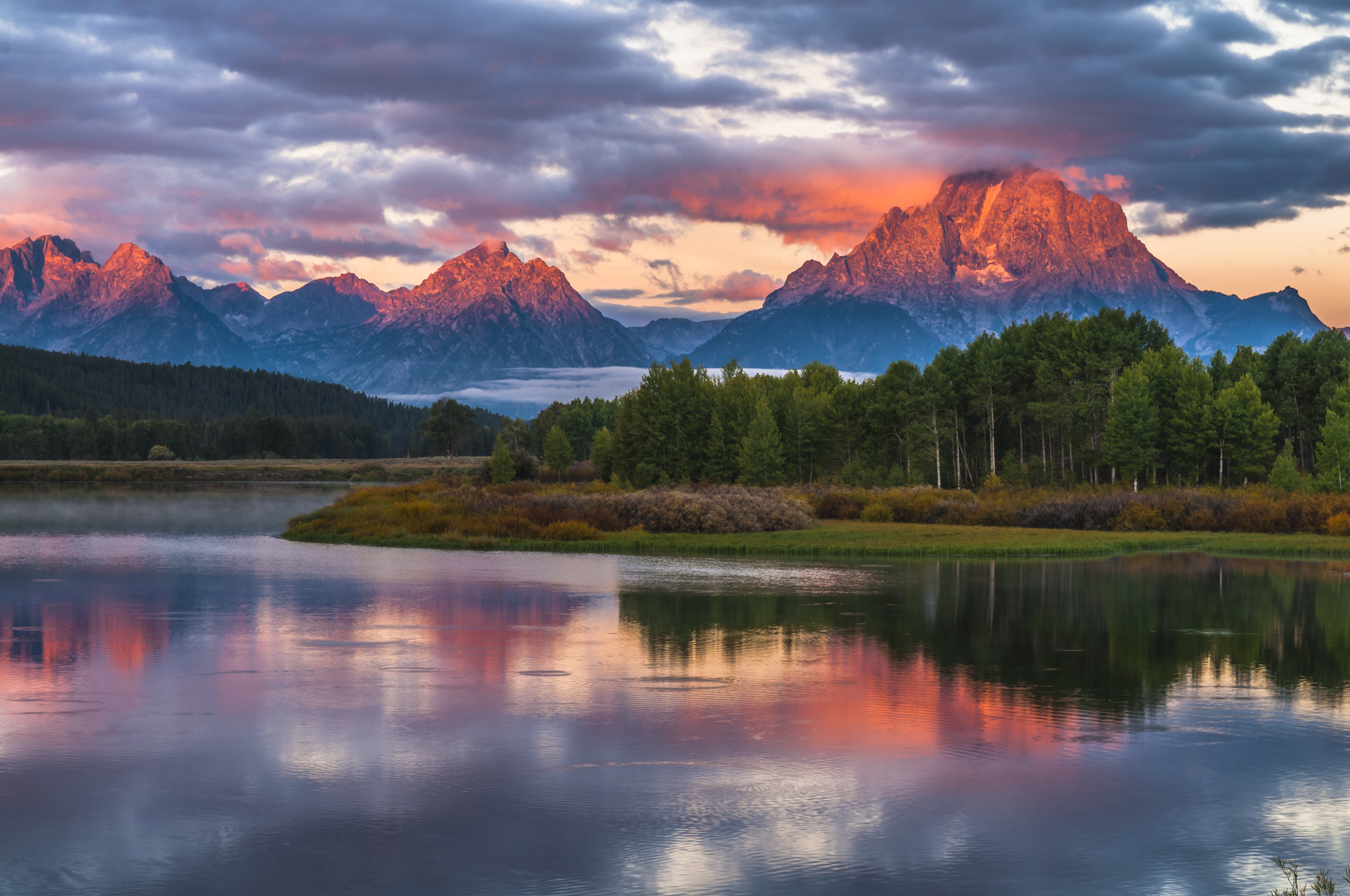
Grand Teton National Park is most beautiful during the sunrise hour of the morning. The best place in Grand Teton to catch a sunrise is from Oxbow Bend where the reflection of Mount Moran dazzles on a clear day. Get here at least 30 minutes early as the limited roadside parking has a tendency to really fill up with photographers. Parkcation
Sunrise is the most spectacular time — the mountains glow pink and orange as the first light hits them, and if the water is calm, the reflection doubles the effect. This is when the serious photographers are there, and it can get crowded fast.
Sunset is beautiful but different. Because the sun sets behind the mountains at Oxbow Bend, the peaks fall into shadow rather than catching golden light. The sky above can still be stunning — especially with clouds — and the wildlife activity at dusk is often exceptional. Just don't expect the same warm mountain glow you get at sunrise.
Mid-morning to afternoon is the least crowded window and still genuinely lovely. The reflection may be less perfect as wind picks up through the day, but the wildlife activity continues and the view of Mount Moran is striking at any hour.
Fall (late September–early October) is many visitors' favorite season overall. The aspen groves along the river turn gold, the summer crowds have thinned, moose are more active, and the combination of fall color, still water, and mountain backdrop is exceptional.
Good to know before you go
Getting there: From Xhale, take US-26 southeast through Swan Valley to Jackson, Wyoming, then US-191/89/26 north through the park. Oxbow Bend is on the highway — you don't need to turn off onto Teton Park Road.
Parking: The parking lot is small. If the parking lot is full, you may have to park along the road — be careful of cars, as they are most likely looking at the view or if an animal is nearby. Arrive well before sunrise for the best chance of a spot in the main lot. Shaka Guide
No hiking required: Oxbow Bend is one of the most accessible viewpoints in any national park. The main view is steps from your car. The informal riverside path is flat and easy. This is a genuinely all-ages, all-abilities stop.
Pets: Pets are allowed in the paved parking area but are not allowed on dirt trails. Letsgoexploringtogether
Year-round access: Unlike many Grand Teton stops, Oxbow Bend is on the main highway and open year-round. The road is kept clear even in winter — though the park interior roads close seasonally.
Park entrance fee: A 7-day vehicle pass for Grand Teton is $35. Annual passes are available and cover both Grand Teton and Yellowstone.
Bug spray: Mosquitoes are active along the river, especially in early morning and evening in summer. Bring repellent — it makes a meaningful difference.
Bear safety: Oxbow Bend is active grizzly and black bear habitat. If you walk along the riverbank, carry bear spray and know how to use it. Maintain 100 yards from bears and wolves, 25 yards from all other wildlife.
Frequently asked questions
Do I need to hike to see Oxbow Bend? No. This is one of the great things about this stop. The main view is visible directly from the parking area and riverbank, which is a short flat walk from your car. There is no trail, no elevation gain, and no experience required. It is genuinely accessible for all ages and fitness levels — including visitors with mobility limitations.
Is sunrise the only good time to visit? Sunrise offers the most dramatic light and the best chance of a perfect reflection on calm water. But Oxbow Bend is worthwhile at any hour. Mid-morning is quieter, afternoon light can be interesting with cloud movement, and wildlife activity is excellent at dusk. In fall especially, any visit during golden hour — morning or evening — can produce extraordinary color.
What is the difference between Oxbow Bend and Schwabacher Landing? Both are Snake River reflection spots in Grand Teton, but they're distinct experiences. Schwabacher Landing reflects the Cathedral Group — Grand Teton, Teewinot, and Mount Owen — and requires a short walk down a gravel road. Oxbow Bend reflects Mount Moran directly from the highway, requires no walking at all, and sits in the northern section of the park. Both are spectacular and complement each other well as part of the same day trip from Xhale.
What wildlife am I most likely to see? Moose are the most reliably spotted large mammal, especially in the early morning and at dusk in the willows along the bank. Trumpeter swans, great blue herons, osprey, and bald eagles are commonly seen on and above the water. Bears — both grizzly and black — are sighted here regularly, as are river otters and beavers. Bring binoculars.
Can I combine Oxbow Bend with other park stops on the same day? Absolutely. Oxbow Bend sits in the northern park and pairs naturally with Jackson Lake Junction (1 mile away), the Signal Mountain Summit Road (a short drive south for panoramic views), and Colter Bay (a few miles north along the lake). Schwabacher Landing in the southern park is about 25 miles south — a full and very rewarding same-day loop from Xhale is possible if you depart by 5:30 a.m.
Is fall really the best time to visit? For many people, yes. Late September through early October brings gold and orange aspen color lining the riverbank, lighter crowds than summer, crisp air, and highly active wildlife — particularly moose and elk. The combination of fall color, Mount Moran, and its reflection in the still water is one of the most breathtaking seasonal views in any national park. If your schedule allows flexibility, this is the window to plan around.
Helpful resources
- Oxbow Bend — National Park Service: nps.gov/thingstodo/oxbowbend.htm
- Grand Teton Park Roads & Visitor Info: nps.gov/grte/planyourvisit/index.htm
- Grand Teton Entrance Fees: nps.gov/grte/planyourvisit/fees.htm
- Xhale Resort & Spa: xhaledayspa.com